
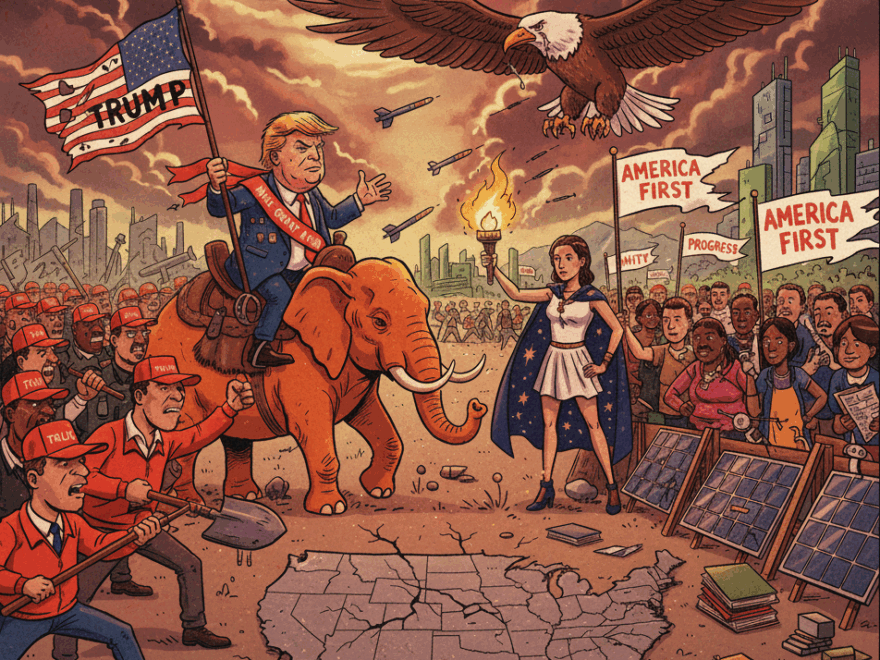
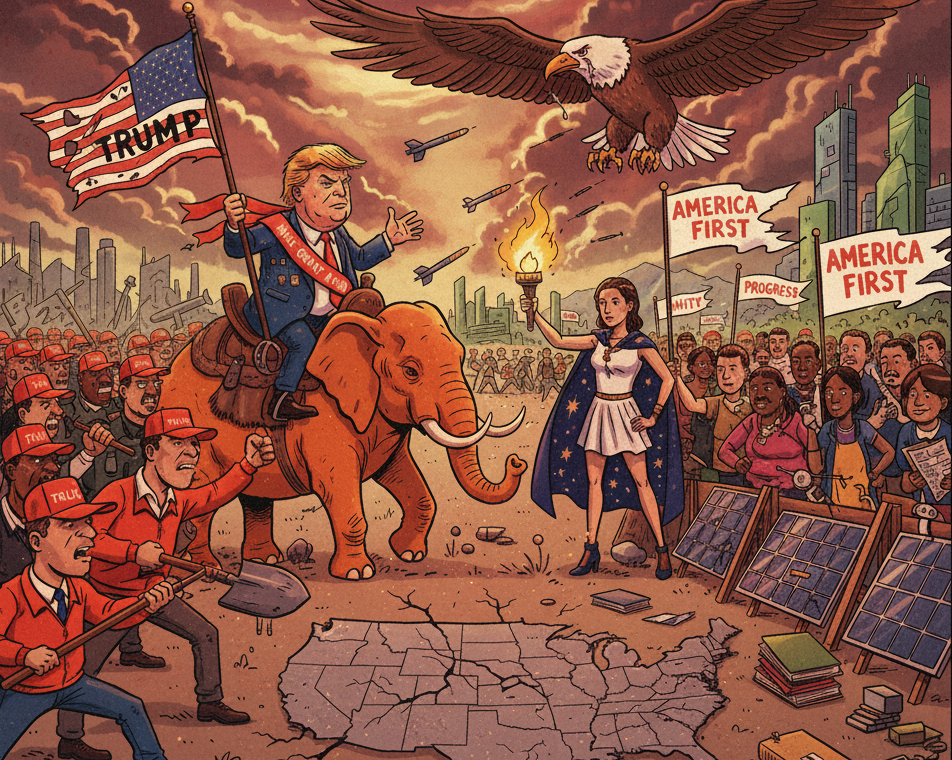
Here’s what happens when you build a political movement on vibes instead of vision: it eventually implodes. And what an implosion we’re witnessing. The Make America Great Again coalition – that seemingly unshakable force that weathered impeachments, insurrections, and enough scandals to sink a dozen ordinary politicians – has fractured into warring tribes that now spend more energy attacking each other than they do the Democrats.
From this side of the world, watching American politics has always been a bit like observing a soap opera where everyone’s simultaneously the villain and the hero. But 2025 has delivered something special: a complete Republican meltdown over issues ranging from skilled immigration to Middle East policy, all while the man who started it all watches his empire crumble in real time.
The delicious irony? The movement that promised to drain the swamp has instead created its own ecosystem of political quicksand, where yesterday’s allies are today’s mortal enemies, and supporting legal immigration or questioning Israeli policy can get someone labelled a traitor faster than one can say “covfefe”.
H-1B Visa Wars
Let’s begin with the controversy that lit the fuse: H-1B visas. In December 2024, the president, Donald Trump – who built his entire political brand on keeping foreigners out, suddenly discovered America needs skilled immigrants. “We don’t have enough talented people,” Trump declared, presumably while standing in a nation of 340 million souls.
The cognitive whiplash was immediate. Right-wing commentator Mike Cernovich captured the mood perfectly: “Trump broke everyone’s heart with this line.” Florida Republican Anthony Sabatini predicted electoral disaster on X with the sort of dramatic flair usually reserved for soap operas: “This is insane – we’re going to lose the midterms so badly.”
The Republican representative from Georgia’s 14th district, Marjorie Taylor Greene, who had previously defended Trump against everything from tax-fraud accusations to attempted-coup allegations, suddenly discovered she had principles. “I am America First and America Only,” Greene proclaimed, positioning herself as defender of American workers against the onslaught of – checks notes – highly educated engineers and doctors.
Here’s the beautiful contradiction that nobody seems willing to acknowledge: the same movement that spent years railing against illegal immigration has now torn itself apart over legal immigration by people with advanced degrees. One might almost think it was never really about the legality of immigration at all.
Shocking, truly.
The battle lines formed quickly. On one side stood Trump’s billionaire tech allies – Elon Musk, Vivek Ramaswamy, David Sacks – arguing America needs foreign talent to compete globally. On the other stood the populist wing led by Steve Bannon, Greene, and Charlie Kirk. Bannon, with his characteristic subtlety, called Musk “truly evil” and advocated for his deportation despite his naturalized citizenship. Because nothing says “America First” quite like deporting naturalized citizens who disagree with you.
The logic is flawless, really.
When Bibi Became Uncle Sam’s Dad
If the H-1B controversy was divisive, the Israel-Gaza debate split the movement like the Red Sea – except Moses isn’t around to guide anyone, and everyone’s arguing about who gets to be Moses anyway.
By July 2025, images of starvation in Gaza had catalysed something unprecedented: Republicans questioning American support for Israel. Greene became the first Republican member of Congress to call Israel’s war in Gaza a “genocide”. Thomas Massie, the Republican representative from Kentucky’s 4th district, posted on X that the conflict was “so lopsided that there’s no rational argument American taxpayers should be paying for it”.
These weren’t fringe figures breaking ranks. These were Trump loyalists abandoning ship with the enthusiasm of passengers who’d just spotted the iceberg.
MAGA podcaster Jack Posobiec explained the split: “What we are seeing on Israel is a generational split around the age of 40. Over 40 support, under 40 range from sceptical to wanting to cut all ties.”
A Turning Point focus group revealed that when Gen Z participants were asked to describe Israel, some responded with terms like “liability” and “tax dollars”. Not exactly the ringing endorsement the Republican establishment was hoping for.
The controversy intensified after Tucker Carlson’s two-hour interview with Nick Fuentes, a white nationalist Holocaust denier. Because when one is looking to have a nuanced conversation about Middle East policy, obviously the first person to call is someone who denies the Holocaust happened. Carlson mocked “Christian Zionists”.
The interview drew six million views, and suddenly MAGA was having the sort of public reckoning about antisemitism that most movements prefer to have privately, if at all.
At the Republican Jewish Coalition’s leadership summit, attendees held signs reading “Tucker is not MAGA.” Ben Shapiro, with his 30 million social media followers, branded Carlson “an intellectual coward” and “the most virulent superspreader of vile ideas in America.” Which, coming from someone who once argued Palestinians like living in sewage, is quite the accusation.
Conservative critics began labelling MAGA as “MIGA” – Make Israel Great Again. They argued the movement had abandoned America First principles by prioritizing Israel’s interests. It’s almost as though simplistic slogans don’t translate well into complex foreign policy realities.
Who could have predicted? Besides literally everyone with a functioning brain, of course.
Epstein Files Fiasco
Then there’s the Jeffrey Epstein files debacle, which is perhaps the most morally straightforward issue dividing MAGA – and yet Trump managed to end up on the wrong side of it. Greene, Massie, and other Republicans demanded full release of sealed documents, arguing survivors deserved truth and accountability. Trump opposed it, dismissing the push as a “Democrat hoax”.
Let that marinate for a moment. We’re discussing releasing documents related to a deceased sex offender whose crimes are extensively documented, and somehow this became controversial within the Republican Party. It’s like arguing that releasing evidence of the Titanic sinking might be politically motivated against icebergs.
Greene told CBS News that Trump’s stance represented a “huge miscalculation”. Massie noted that 89% of Americans supported releasing all Epstein files. Think about that polling for a second. When 89% of Americans agree on anything in 2025, one has achieved a level of consensus typically reserved for propositions like “puppies are cute” or “traffic jams are annoying.”
And yet Trump opposed it, threatened primary challenges against Republicans demanding transparency, and eventually reversed course only after sustained pressure.
In July, Massie told reporters: “I have the people on my side.” He warned fellow Republicans: “You will have voted to protect paedophiles if you don’t vote to release these files. And the president can’t protect you then.” Which is both morally correct and politically astute – a rare combination in contemporary American politics.
Finally, seeing no way out, Trump made a stunning U-turn and urged his party members to vote to release the files, apparently because “he had nothing to hide.”
Indeed.
Forever Wars
Perhaps the Trump administration’s most glaring contradiction involves its foreign policy. Trump campaigned on ending “forever wars” and bringing troops home. His second administration then launched strikes on Yemen’s Houthis, bombed Iran’s nuclear facilities, escalated support for Ukraine, and maintained aggressive Middle East engagement. It’s like promising to become vegetarian and then opening a steakhouse.
Hardcore isolationists like Carlson, Bannon, and Kirk pushed back. Carlson labelled Iran support “complicit in endless war,” while Green and Bannon slammed Iran and Venezuela hawks as “neocons in MAGA clothing.” Because apparently the only thing worse than a neocon is a neocon pretending to be MAGA.
Yet polling revealed something surprising: 73% of MAGA Republicans supported the view that the United States should “lead on the international stage.” An overwhelming 96% believed a strong military was essential for peace and prosperity. This suggests MAGA voters aren’t truly isolationist – they’re suspicious of elite-driven “globalist” agendas that don’t serve American interests. Which is a considerably more nuanced position than campaign slogans suggested.
But nuance doesn’t fit on red baseball caps, does it? “Make America Great Again” has four syllables. “We support a robust military presence that serves demonstrable American interests while avoiding entanglement in conflicts that primarily benefit other nations or corporate entities” has … well, significantly more than four syllables.
Tariffs and Grocery Prices
Trump’s tariff policies created another fault line. While MAGA-supporting Republican men over 35 remained optimistic, non-MAGA Republicans increasingly soured on economic conditions. Nearly half of non-MAGA Republicans thought the economy had worsened in 2025, while the overwhelming majority of MAGA Republicans believed it had improved – a staggering 66-point gap.
Grocery prices rose 0.6% in single months. Clothing prices climbed 0.5%. A BBC story captured the mood with a remark by Nancy Garcia, a middle-income New Yorker: “Now I’m doing more price comparison.” Which is polite American for “I can’t afford the things I used to buy.”
Nearly one in four MAGA-supporting Republicans opposed tariffs. They recognized the tariffs raised costs and hurt businesses. Tariffs are essentially taxes on consumers dressed up in nationalist rhetoric. The fact that even a quarter of MAGA Republicans recognize this suggests reality is starting to penetrate the bubble, like water slowly seeping through a concrete dam.
Greene seized on economic anxiety to criticize Trump’s focus on foreign affairs over domestic concerns: “Cost of living is far too high. Health insurance is completely out of control.” She argued that prioritizing foreign policy over inflation and healthcare costs represented an abandonment of the economic populism that energized MAGA’s base. In other words: people care more about affording groceries than about military adventures in Yemen.
Revolutionary insight, truly.
Rogues’ Gallery
The cast of characters in this drama deserves its own analysis. There’s the vice-president, JD Vance, 40, positioning himself as Trump’s heir while maintaining enough ideological flexibility to defend whatever position Trump takes today, regardless of what he said yesterday. Which is exactly what one would expect from someone whose job security depends on Trump’s approval.
There’s the secretary of state, Marco Rubio, who represents the hawkish interventionist wing that believes “America First” somehow means military engagement across the Middle East. He advocated for “disproportionate” responses in Gaza and called for Hamas to be “exterminated”, because nothing says measured diplomacy like advocating for extermination.
Musk transformed from major campaign donor to Bannon’s sworn enemy after defending H-1B visas. Despite Bannon declaring “MAGA’s done with him,” Musk’s financial resources and tech influence remained significant. It’s almost as though billionaires don’t actually lose influence just because someone declares them cancelled.
Billionaire David Sacks went from calling Trump’s candidacy “clearly off the table” after the January 6 Capitol Hill riots to likening his return to “Caesar entering Rome.” Because comparing American presidents to dictators who overthrew republics is apparently fine when it’s your dictator.
On the dissidents’ side, Greene experienced a dramatic fall from grace – from Trump’s most reliable congressional supporter to being called “wacky” and a “traitor” by Trump himself. Just a couple of days ago, she, without taking Trump’s name, hit back at him saying, “Let me tell you what a traitor is. A traitor is an American that serves foreign countries (read Israel).”
Carlson positioned himself as an America First purist, his podcast reaching millions of younger conservatives sceptical of foreign entanglements. Bannon represented working-class populism, feuding spectacularly with Musk and calling for his deportation. Massie emerged as the libertarian-populist gadfly, defying Trump by leading the Epstein files release campaign.
Then there’s the truly colourful characters. Prominent pro-Zionist conspiracy theorist and Trump ally Laura Loomer, who describes herself as a “proud Islamophobe”, accused Carlson of being “owned by Muslims” and called him “Tucker Qatarlson”. Because nothing says principled conservatism like playground name-calling with an Islamophobic twist.
Candace Owens hosted Norman Finkelstein on her podcast, called Gaza a “holocaust”, and accused pro-Israel forces of pressuring Kirk before his assassination. Fuentes, the antisemitic white nationalist, represented the extreme fringe that some America First advocates tolerated or embraced, forcing a reckoning over whether the ideology inevitably attracted extremists.
This Rupture Cannot Heal
Several structural factors ensure this schism deepens rather than heals. The generational divide cannot be bridged through political manoeuvring. You see, 71% of older Republicans identify as MAGA supporters compared to only 59% of younger Republicans. These cohorts have fundamentally different life experiences and values. One cannot negotiate away the fact that one generation remembers the Cold War and another grew up with social media.
The economic class conflict between billionaire donors and working-class supporters is equally unbridgeable. One cannot simultaneously serve tech oligarchs who need H-1B visas and workers who feel economically threatened by immigration. Someone loses. It’s basic maths, really, though apparently not the kind of maths they teach at Turning Point USA rallies.
Trump’s simultaneous embrace of isolationist rhetoric and interventionist action creates cognitive dissonance his supporters cannot ignore indefinitely. One cannot bomb Iran while promising to end forever wars. One cannot escalate military aid to Ukraine while campaigning against foreign entanglements. Eventually, people notice the gap between words and deeds – even people who own multiple MAGA hats.
The Epstein files controversy uniquely cut across other divides, uniting disparate America First figures behind transparency while Trump opposed it. When 89% of Americans support release but the president resists, any Republican defending Trump faces electoral vulnerability.
The conservative media ecosystem has fragmented beyond Trump’s control. Carlson’s podcast, Owens’ show, Bannon’s War Room – these create alternative information ecosystems where Trump no longer controls the narrative even among his supporters. It’s like watching a cult leader lose control of the cult’s communication channels.
Awkward.
The movement’s foundational appeal rested on ideological purity – drain the swamp, end corruption, put America first. Yet governing requires compromise, accommodation of donors, and pragmatic policy choices that contradict campaign rhetoric. Greene articulated this tension: “I believe in the American people more than I believe in any leader or political party.”
When forced to choose between Trump personally and America First principles, a growing number chose principles. Which would be admirable if the principles themselves weren’t quite so questionable.
A Telescopic View
As a foreign observer from India who has watched American politics with keen interest for years, there’s admittedly some schadenfreude here. The movement that reshaped American conservatism, that seemed unstoppable in its devotion to Trump, has discovered that cult of personality makes for poor long-term political strategy.
The contradictions were always there – between populism and plutocracy, between isolationism and interventionism, between loyalty to a person and adherence to principles. Trump’s genius was keeping these contradictions suppressed through force of personality and constant distraction. But governing requires actual policy choices, and policy choices reveal whose interests one truly serves.
By November this year, we’ve learned that you can’t build a political movement that’ll keep on rolling when it’s all based on worshipping one person and chanting catchy slogans. Eventually, reality intrudes. People notice when their grocery bills rise. They question why American taxpayers fund foreign wars when domestic infrastructure crumbles. They wonder whether “America First” means anything if it changes based on who’s writing the biggest cheques.
Greene’s admission that political rhetoric had become “poisonous” marked a watershed – one of MAGA’s founding figures acknowledging the movement had lost its way. Kirk’s assassination and all the conspiracy theories swirling around it have only deepened the cracks in what was already a pretty fragmented coalition.
Trump still has his grip on the Republican Party machinery, sure, but the fact that an America First faction has emerged that’s actually willing to stand up to him shows his iron hold isn’t quite what it used to be. The MAGA coalition that swept Trump into power was always a bit of a shaky alliance between groups that didn’t really fit together. By 2025, that alliance has well and truly fallen apart, and there’s no putting it back together again.
What emerges from this rupture will define American conservatism for the next generation. Whether it’s a Trump-loyal MAGA establishment or a renewed America First movement committed to principles over personality remains to be seen.
One thing is certain, though: movements built on contradiction eventually collapse under their own weight. We’re watching that collapse in real time. And while one certainly wouldn’t have chosen this path for American democracy, there’s no denying it has been extraordinarily entertaining theatre.