
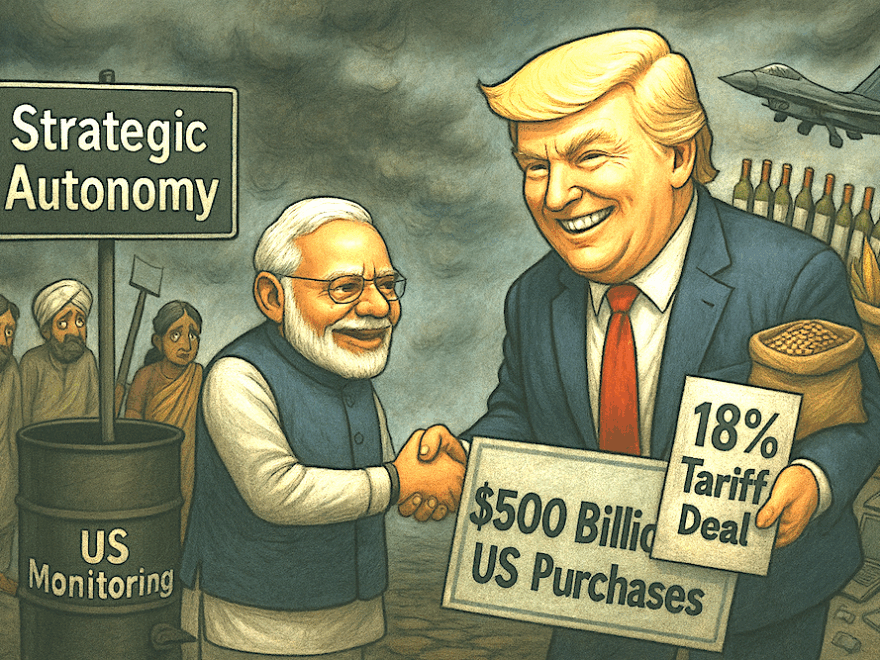
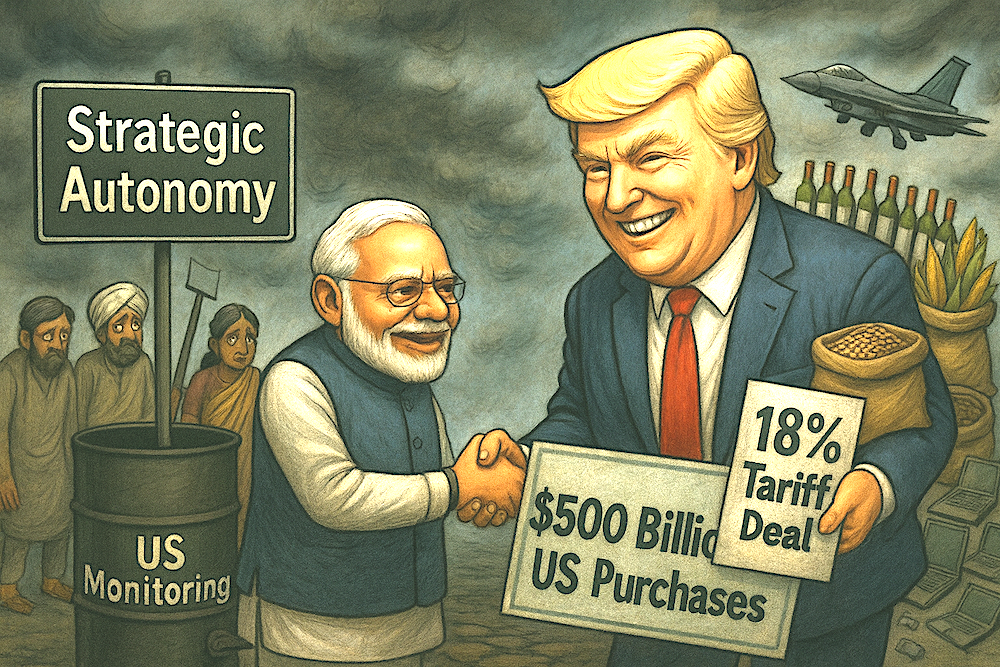
Let’s all pause and applaud. India – the civilizational superpower, the world’s most populous democracy, the inheritor of a foreign-policy tradition that once had the audacity to coin the very phrase “strategic autonomy” – has just concluded a landmark trade deal with the United States. The commerce minister, Piyush Goyal, beamed as he called it a triumph. The prime minister, Narendra Modi, presumably nodded approvingly from a great moral height.
And somewhere in a New Delhi thinktank, a couple of policy analysts were quietly asked to write a paper explaining why losing is, in fact, winning.
The February 2026 India-US tariff deal, hailed by the government as a decisive reset, deserves a rather different headline: how a $45 billion trade surplus was cashed in for a monitoring mechanism, a $500 billion shopping obligation, and a tariff rate that is still roughly six times higher than what Indian exporters faced before this whole spectacular crisis began. But don’t worry – according to official sources, this is called “progress”.
A Crisis India Walked Into, with Eyes Wide Open
To understand the full splendour of this capitulation, one must appreciate the context. After Russia’s 2022 invasion of Ukraine, India – exercising the famous strategic autonomy – began importing discounted Russian crude at such enthusiasm that, by 2024-25, Moscow accounted for roughly 40% of India’s oil supply. Cheap oil for a price-sensitive, inflation-haunted economy: sensible enough. But then came the second Trump term, and with it, a 50% tariff on Indian goods – a number so alarming that it briefly made Indian economists forget their usual decorum and reach, collectively, for a stiff drink.
Washington imposed an initial 25% “reciprocal” tariff in mid-2025 and then, in a move that combined geopolitical lecturing with economic blunt force, slapped on a further 25% in August 2025 explicitly to punish India for buying Russian oil. Note the elegant hypocrisy: China was purchasing even larger volumes of Russian crude yet faced no such surcharge. The US, it appears, found it considerably easier to financially bludgeon a democracy that was also a strategic partner than to pick that particular fight with Beijing.
India, ever gracious, absorbed the insult – and then sat down to negotiate.
Economists projected that if the tariffs held, India’s GDP could contract by as much as 0.8% and US-bound exports could fall by around $35 billion in a single year. Small and medium enterprises – the beating, underpaid heart of India’s labour-intensive export sector – were, to use the technical term, absolutely hammered. Textile hubs in Tiruppur and Surat reported acute distress.
Reports emerged of order cancellations, layoffs, and a mass migration of buyers toward Vietnam and Bangladesh. India’s weavers, gem-cutters, and leather craftsmen, who had never quite grasped the finer points of US presidential frustration with Indian trade policy, found themselves suddenly and brutally enrolled in a geopolitics seminar.
Surrendering the Surplus, Keeping the Smile
After months of what were described in official communiqués as “constructive negotiations” – a phrase that, in Indian diplomatic parlance, generally means “one side talked, and the other side listened” – New Delhi and Washington announced their framework agreement earlier this month. The headline: US tariffs on Indian goods cut from 50% to 18%. The commerce minister called it “transformative”. The White House called it “historic”. Donald Trump called it “great”.
And so, in the tradition of those who celebrate the partial restoration of what was taken from them, New Delhi declared victory.
Let’s be clear about what 18% actually means. Before this adventure began, the average US tariff on Indian goods sat at a comfortable 2–3%. The new “triumph” leaves Indian exporters paying six to nine times that rate, locked into a deal whose fine print includes a $500 billion purchase commitment for American goods – energy, aircraft, advanced technology, and the like – spread over five years.
India is, in essence, being asked to subsidize American industry while its own exporters remain burdened with tariffs that would have been unthinkable five years ago. But look on the bright side: diamonds and generic pharmaceuticals got zero-tariff access! Surely the mango farmers of Ratnagiri will sleep soundly now.
The Invisible Losers
The government has, with characteristic grace, assured everyone that “sensitive agriculture” has been shielded. This is reassuring, until one reads the fine print. India has agreed to cut or eliminate tariffs on a range of US agricultural imports: tree nuts, fruits, soybean oil, animal feed, wine, and spirits. For Indian farmers who operate on wafer-thin margins – and who lack anything resembling the gargantuan subsidies enjoyed by American agribusinesses – the arrival of cheaper American produce is not a cause for celebration. It is a cause for despair.
A wheat farmer in Punjab and a nut grower in Kashmir don’t have the luxury of absorbing competition from a country that spends tens of billions of dollars annually propping up its own agricultural sector.
India’s MSMEs – a category covering an estimated 63 million enterprises and providing livelihoods to roughly 110 million people – have already lived through the trauma of demonetization, the teething troubles of the GST, and an economy-crippling pandemic. Their reward for this resilience was a front-row seat to a tariff war they had no hand in starting.
The Global Trade Research Initiative thinktank in Delhi has described the deal’s terms as an “uneven exchange”, and the arithmetic bears this out: the US reduces tariffs on about 55% of Indian exports, dropping them from a punitive 50% to a merely uncomfortable 18%, while India opens its markets broadly to American goods. Who negotiated this, one wonders – or did New Delhi simply send its shopping list to Washington and ask them to fill in the concessions column?
The small exporter in Surat who was sending embroidered textiles to boutiques in New Jersey has not been invited to the news conferences. Nor has the farmer in Andhra Pradesh who grows maize and will shortly find himself competing with US corn that has been so thoroughly subsidized that it practically arrives with a complimentary Stars and Stripes.
Future rounds of the promised bilateral trade agreement may push for further agricultural opening, including dairy – a sector so politically and emotionally charged in India that merely mentioning it in the wrong constituency can end political careers. The Modi government has breezily described this as a matter for future negotiations. The farmers involved might describe it rather differently.
‘Strategic Autonomy’ – A Phrase in Search of a Policy
Perhaps the most darkly comic element of this entire episode is what has happened to the phrase “strategic autonomy”. For years, Indian foreign-policy veterans deployed it with the gravity of a sacred mantra. It meant: India buys from whom it wishes, aligns with whom it chooses, and takes instructions from no one. The government applied it robustly when criticizing Pakistan, enthusiastically when defending Russian oil purchases, and reflexively whenever Washington asked uncomfortable questions about human rights or press freedom. It was, in short, a very useful phrase.
It is now considerably less useful. The February deal includes a formal monitoring mechanism – administered by Washington – over India’s future oil-sourcing decisions. This is not a gentle suggestion from a friendly partner. It is a written, US-administered trigger: if Washington decides India is “non-compliant” in its Russian crude imports, the 25% punitive surcharge snaps back into place.
India’s energy policy, once a sovereign decision made in New Delhi, now has a compliance review mechanism operated in Washington. Nagpur logic dictates that we call this what it is: “conditionality”. The kind that the International Monetary Fund used to apply to developing nations in exchange for emergency loans, dressed up here in the language of trade partnership.
To be scrupulously fair: India has not technically signed away its right to buy Russian oil. What it has done is created an arrangement in which exercising that right carries an automatic economic penalty determined unilaterally by Uncle Sam. The distinction, one imagines, brings great comfort to the philosophy department.
For the refineries, the oil ministry, and the current account, the practical effect is somewhat similar. India’s defenders in the government will insist that this is “pragmatism” and that “sovereign states recalibrate all the time”.
This is true. Sovereign states also, all the time, find more polite language for the word “surrender”.
The Precedent Problem
The White House, to its credit, has been admirably candid. Officials noted with undisguised satisfaction that “tariff pressure succeeded where diplomacy alone had not” – compelling India to reduce Russian oil purchases and open its markets more widely to American goods. This is the part that should give every Indian strategic planner a sleepless night. What Washington has just demonstrated, in full public view, is that sufficiently aggressive tariff pressure can extract substantial concessions from even a large, loud, and self-consciously sovereign economy like India. This lesson won’t be forgotten.
It will be filed, annotated, and reapplied.
For the first time in Indian diplomatic history, a formal, written, US-administered mechanism has been established linking India’s energy-sourcing choices to the tariff treatment of its exports. If this template is normalized – and there is every reason to think it will be – it can be reached for again on any number of issues: digital regulation, data localization, defence procurement, treatment of American technology firms operating in India. The ceiling on India’s freedom to manoeuvre has been lowered, quietly and formally, in a document that Goyal and Modi celebrated as a victory. Future US administrations will have read the footnotes even if the celebrants have not.
Scorecard Nobody Wants to Print
Let’s draw up the scorecard as honestly as the government’s communications apparatus won’t. The US gets: a visible, monitoring-backed reduction in Indian purchases of Russian crude; a $500 billion export pipeline for American energy, defence, and industrial firms; meaningfully improved access to India’s vast consumer market, particularly in agricultural goods; and a demonstration, for the benefit of every other trading partner watching, that tariff shock therapy works. India gets: a tariff rate of 18% – which is worse than the baseline that existed before Washington started the crisis – zero duties on diamonds and generic pharmaceuticals, and a promise that the forthcoming bilateral trade agreement will be, if the government’s PR machinery is to be believed, tremendously advantageous.
The government, naturally, compares the 18% rate not with the pre-crisis norm of 2–3% – which would be honest – but with the emergency 50% tariff that Washington itself imposed – which is the intellectual equivalent of praising a mugging victim for having the presence of mind to hand over only their wallet rather than their watch as well. India is apparently beating Vietnam and Bangladesh in the tariff league table by a single percentage point. Given that both countries have managed not to have their trade surplus converted into a Washington monitoring obligation, one suspects they are sleeping better.
What of India’s farmers, its weavers, its gem-cutters, the small factory owners of Tiruppur and Ludhiana, and the millions of MSME employees whose livelihoods hang on export orders? They remain in a worse position than they were in 2024, facing tariffs that are still elevated, watching their government obligate itself to spend half a trillion dollars on American goods, and hoping, with the somewhat desperate optimism of those who have no other option, that the promised bilateral trade agreement will be kinder to them than the interim arrangement has been. The government assures them it will be.
The government also assured them, in 2016, that demonetization would be over in 50 days.
Necessary Compromise, Dishonestly Sold
To be precise – because precision is what distinguishes analysis from propaganda – there is a legitimate case that India had little choice. The sustained 50% tariff threatened to do real and lasting damage to the economy. The arithmetic of cheap Russian oil versus lost export markets was always going to resolve in favour of accommodation. The US is India’s single largest export destination. These are facts, not excuses. A government that continued to absorb the tariff hammer out of wounded national pride would have been making its own exporters and workers pay the price for a philosophical position. There is a real argument for the deal as damage limitation.
The problem is not the compromise. The problem is the dishonesty with which it is being sold. A government with genuine confidence in its own decisions would look the country in the eye and say: we made a pragmatic call, we traded some policy latitude for economic stability, here are the costs, here is how we will manage them, and here is the strategy for ensuring we are never in this position again. That would be leadership. What we are getting instead is a minister with a broad grin announcing that the day’s defeat is, in fact, a glorious morning.
That is PR. It is not governance.
India’s farmers and small exporters, who are the real price-payers in this arrangement, deserve honesty. They deserve to know that their government accepted a monitoring mechanism over its sovereign energy choices. They deserve to know that the tariff rate they will be exporting under is six times the pre-crisis norm. They deserve to know that future rounds of trade negotiations may open sectors – agriculture, dairy – that have thus far been kept partially sheltered. And they deserve a credible government plan for export diversification, market development, and investment in MSME competitiveness that goes beyond announcing a new acronym every budget cycle.
For now, what they have is a commerce minister who is very pleased with himself, a prime minister who has not been seen discussing the monitoring mechanism in any public forum, and a trade deal that the White House is, with commendable candour, describing as proof that pressure works. On that last point, at least, everyone is in agreement. India bent. The deal got done. The commerce minister called it a triumph. And somewhere in Tiruppur, a textile worker waited to hear whether his factory’s next order would come through – or whether it would, once again, go to Vietnam instead.