
My grandfather was a freedom fighter who spent years in a British colonial jail – tortured with the methodical efficiency that only a truly civilized empire could muster. He never complained much. As my grandmother used to say, he believed that oppressed people who resist simply do what must be done.
I never knew him – he passed when I was just a few months old – but I’ve thought of him constantly over the past three years, watching one of the world’s most powerful militaries pound one of its most densely populated territories into rubble, while the architects of that carnage lecture the rest of us on terrorism.
Welcome to the extraordinary moral theatre of the post-October 7, 2023, world – where the occupier is always the victim, the occupied are always the terrorists, and pointing this out gets you labelled antisemitic. Grab your popcorn. Actually, don’t – there’s no popcorn in Gaza. There’s very little of anything there, including children who still have both their legs.
The ‘Surprise’ That Wasn’t
On October 7, 2023, Hamas and allied Palestinian factions launched a coordinated assault from Gaza, resulting in the death of approximately 1,200 Israelis – many of them civilians – and taking more than 240 hostages. It was brutal. It was horrifying. And, if we’re being honest, it was entirely predictable to anyone paying attention – which, as it turns out, included Egyptian intelligence, who warned Israel repeatedly that “something big” was being planned from Gaza.
Israel, flush with confidence in its surveillance apparatus and its “smart fence”, ignored those warnings with the serene self-assurance of someone told their house is on fire who’s too busy rearranging furniture to check.
Israel’s Shin Bet later concluded that Israel had actually obtained Hamas’s detailed battle plan years earlier but dismissed it as unrealistic – presumably filed under “Implausible Scenarios”, somewhere between “Netanyahu Resigns on Principle” and “Settlement Construction Paused for Reflection”. The same report noted that a policy of maintaining “calm” with Hamas had enabled its “massive buildup”.
Translated: the Israeli government knew, looked away, and is now surprised by what it saw.
And here a son of India’s freedom struggle can’t help but ask an uncomfortable question. Our own Revolt of 1857 saw innocent British civilians – women and children among them – killed in the violence that followed. Should we Indians call 1857 terrorism? Should Mangal Pandey be listed alongside the world’s most wanted?
Most Indians, and most of the global south, already know the answer.
Armed resistance against an occupying force is explicitly sanctioned under international law. A substantial body of legal scholarship holds that the Hamas attack, however deeply regrettable in its civilian toll, falls within the framework of legitimate resistance to an occupation now entering its eighth decade.
Netanyahu’s Strategic Genius
Let’s pause to acknowledge Benjamin Netanyahu’s extraordinary strategic vision. For years, he quietly facilitated the transfer of Qatari funds to Hamas – explicitly, as he told his own party in 2019, to prevent a unified Palestinian political front and block movement toward a two-state solution. He was, in his own words, investing in Hamas as a counterweight to the Palestinian Authority.
The EU’s foreign-policy chief, Josep Borrell, and numerous former Israeli intelligence officials have confirmed this with remarkable candour. Funding the organization that later breached your border and triggered your worst crisis in history – in cricket, we’d call that a spectacular misjudgment of the pitch.
Netanyahu has since invoked the Holocaust and the memory of the “six million” to justify a campaign that his own country’s Holocaust scholars are now debating whether to classify as genocidal. Historian Amos Goldberg has argued that institutional Holocaust memory has been weaponized not to restrain but to justify the Gaza war. One wonders what the inmates of Auschwitz would make of their suffering being used as diplomatic cover for bombing schools.
Numbers That Can’t Be Unseen
Let’s talk about numbers, because numbers don’t respond to press releases. By February 2026, compiled estimates put Palestinian deaths in Gaza above 73,000 since October 7, 2023. UN and health-agency data had already recorded approximately 31,000 deaths by mid-March 2024, with a distressingly high proportion of women and children. A record 383 humanitarian workers were killed globally in 2024 – nearly half of them in Gaza.
Foreign doctors returning from Gaza have told European and American media that they treated more than 100 children with single bullet wounds to the head or chest – a pattern that, in their professional judgment, is inconsistent with crossfire and suggests deliberate targeting of minors. The IDF, naturally, disagrees completely. Presumably there’s a PowerPoint somewhere in Tel Aviv explaining why snipers shooting children in the forehead is a defensive measure.
Medical literature has described unprecedented rates of child death relative to other recent conflicts, alongside large numbers of children suffering amputations, malnutrition, and psychological trauma. A generation is being destroyed – not metaphorically, but literally, limb by limb, school by school. The Lancet estimated in July 2024 that over 186,000 Gazans had been killed – and that was less than nine months in. Some scholars put the real death toll upwards of 680,000.
October 7 Hannibal Doctrine
Even the events of October 7 itself are more complicated than the clean victim narrative that was served to the world. Investigations by Israeli outlets including Haaretz reported that IDF commanders invoked the controversial “Hannibal directive” – an informal doctrine permitting broad use of force to prevent soldier capture, even at the risk of killing the captives themselves.
Attack drones and helicopters apparently fired on vehicles where abductees were believed to be present. The Knesset also shot down a proposal to establish a state inquiry into October 7. On that day, Israeli doctrine treated its own hostage citizens as acceptable collateral damage. One is reminded of every colonial power that has ever sacrificed its own people to protect the system that sustains them.
World Has Noticed, and Israelis Helped
When polling in the United States – historically Israel’s most faithful cheering section – shows disapproval of Israel’s military actions at around 60 per cent, and when Gallup records support for Israel’s military campaign at a historic low of 32 per cent, something has shifted that is very difficult to unshift.
When over 80 per cent of Israelis supported their government’s Gaza policies – even while most personally disliked Netanyahu – they made a democratic choice with consequences they must now reckon with. The opprobrium raining down on Israel from around the world isn’t a sudden outbreak of global antisemitism. It’s the natural response of a watching world to what it has seen. Seventy thousand dead civilians in 18 months tends to produce a reaction, even among the sympathetic.
Jewish dissent has been remarkable. Organizations like Jewish Voice for Peace have organized mass protests and campaigns explicitly labelling Israel’s actions a genocide. Even inside Israel, growing majorities say it’s time to end the war and that Netanyahu should take responsibility for October 7 and resign. Apparently, even citizens of the country whose government insists the campaign is righteous suspect something has gone very wrong.
Enter Iran, Stage Right, with Missiles
And then – just when it seemed things couldn’t deteriorate further – Netanyahu and Donald Trump found a way. On February 28, Israel, in coordination with the US, launched large-scale airstrikes across Iran, hitting military and government sites in at least two dozen provinces. The strikes killed Iran’s supreme leader, Ali Khamenei, at his Tehran residence, along with several family members.
An elementary school for girls in Minab, southern Iran, was hit, killing approximately 170 little schoolgirls between 7 and 12 and some of their teachers in or adjacent to the building. Satellite imagery suggested that a US-made cruise missile struck a compound next to the school. US officials helpfully implied some civilian casualties may have resulted from Iranian air-defence misfires, a claim probably not appreciated by the parents of the dead schoolgirls. In the same day, 20 female volleyball players were killed when a sports facility in Lamerd was struck.
Let’s sit with this. The same country that built its entire post-war diplomatic identity on the principle that the mass killing of civilians – particularly children – is civilization’s supreme crime, has now bombed a girls’ school. In Iran. With American weapons.
Polling data already show that support for Israel’s actions in Iran is even lower than the already-dismal support for its actions in Gaza among Americans. Even Israel’s defenders are struggling to explain how bombing a girls’ school advances civilizational defence.
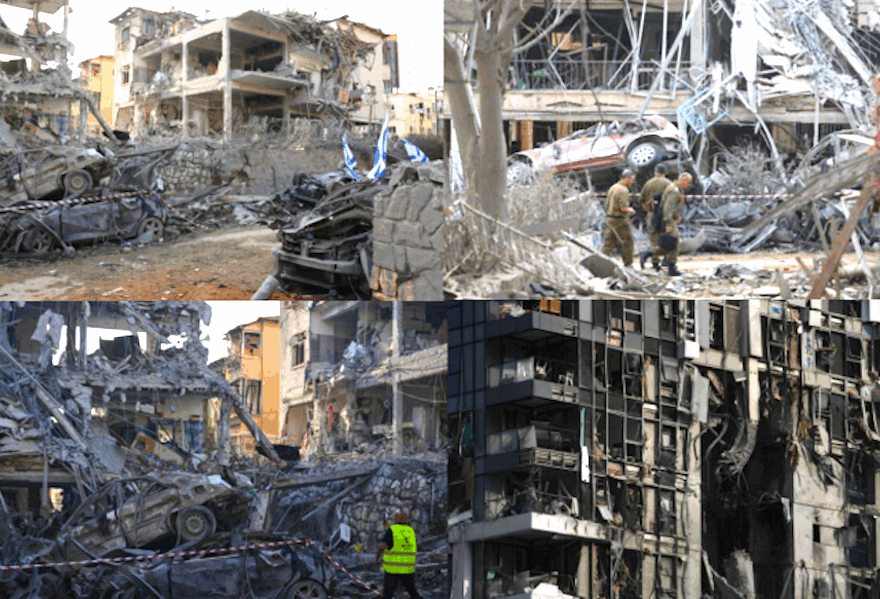
Iran’s response was not long in coming. Within weeks, the Islamic Revolutionary Guard Corps launched successive waves of ballistic missile and drone strikes at Israeli territory, several reaching Tel Aviv and the port city of Haifa. Israel’s Iron Dome and Arrow systems performed creditably – intercepting the majority – but the arithmetic of attrition is unforgiving, and enough got through to kill, damage, and, above all, to demonstrate that deterrence had spectacularly collapsed on the altar of Netanyahu’s audacity.
For a country that had spent decades marketing its military invincibility as a kind of geopolitical brand identity, this was not a good quarter for the brand.
What the architects of the February 28 strikes apparently did not fully model was the regional calculus. Hezbollah, already bloodied but far from depleted, resumed its northern bombardment with renewed intensity. Houthi missiles – launched from Yemen, coordinated through channels that Washington insists are directed from Tehran – began landing closer to Ben Gurion Airport than any scenario Israel’s defence planners had publicly acknowledged was plausible. The Red Sea, already contested by months of maritime disruption, tightened further.
Israel had, with one night’s strikes, managed to unite every adversary on its periphery in a shared project. In strategic studies, this is what they call a “sub-optimal outcome”.
The international legal dimension has been equally clarifying. The International Court of Justice, which had already been deliberating South Africa’s genocide case against Israel, found itself confronted with an entirely new body of evidence. Killing a sitting head of state – whatever one thinks of that head of state – occupies a very specific position in international law, one not obviously compatible with the rules-based order that Washington invokes with such regularity. The Biden administration spent four years warning Israel not to strike Iranian leadership.
The Trump administration apparently concluded that this restraint had been insufficiently creative. The world is now living with that creativity.
‘Soundtrack of Accumulated Rage’
The cultural fallout has been vivid. A song titled “Boom! Boom! Tel Aviv”, circulated widely over footage of Iranian missiles striking Israel, became a global viral phenomenon with hundreds of millions of views. Its lyrics frame the strikes as retribution for dead Palestinian children. An Iranian media report described it as a “soundtrack of accumulated rage and hatred against Israeli policies”.
One may find such expressions distasteful – there’s something genuinely uncomfortable about celebrating missiles hitting any civilian area. But the song’s reach is itself diagnostic: across the global south and among western youth, identification has shifted strongly, perhaps irreversibly, away from Israel. A country that once wore victim status as geopolitical armour has, with considerable effort, transformed itself into the villain of the world’s most-watched story.
It didn’t stop at one song. The weeks following the Iran strikes produced an outpouring of art, music, and street murals across the global south that would have confounded anyone still operating on the assumption that the old hierarchies of sympathy hold. In cities from Karachi to Nairobi, from Jakarta to Bogota, images of Iranian missiles arcing across a night sky appeared alongside photos of Gaza’s dead children – stitched together into a single visual grammar of accumulated grievance.
The message was not subtle. It wasn’t trying to be. Subtlety is a luxury of those whose children are not being buried under rubble.
Western commentators who found this distasteful made a category error that is worth naming. They confused the messenger with the message. The rage that produced “Boom! Boom! Tel Aviv” was not manufactured by Iranian state media, however enthusiastically Iranian state media amplified it. It was assembled, brick by brick, from two and a half years of footage that the world was not supposed to keep watching but kept watching anyway – the children in the rubble, the hospitals without anaesthesia, the journalists shot in the chest wearing press vests, the flour convoy massacres.
Iranian propagandists didn’t create this sentiment. They simply recognized that the warehouse was full and struck a match.
There is, in this cultural moment, a generational rupture that deserves its own paragraph. Among adults over 50 in the western world, the Holocaust framework – Israel as the world’s permanent exception, its security needs as categorically different from those of other states – still carries considerable gravitational pull. Among those under 35, and particularly those who came of age on social media watching real-time footage of Gaza, it largely does not.
The arguments that worked on their parents – appeals to historical guilt, invocations of antisemitism, warnings about the uniqueness of Jewish suffering – land differently, or don’t land at all, on a cohort that watched a UN agency documenting child famine be defunded by its ostensible protectors. What Israel’s communications apparatus calls “delegitimization” is, in many cases, simply the predictable consequence of people believing what they see.
Reckoning My Grandfather Understood
My grandfather wouldn’t have been surprised by any of this. He would have recognized the pattern immediately – an occupying power convincing itself its violence is defensive, its opponents are terrorists, and the laws of war apply to everyone but itself. He would have recognized the willingness to kill children and call it collateral damage while demanding the world’s sympathy for its own dead.
Netanyahu’s grand strategy – contain the Palestinians through military superiority, keep Gaza quarantined, lean on Washington, let the occupation run indefinitely – has produced its precise logical consequences. It didn’t prevent October 7. It generated a Gaza campaign now widely characterized as genocidal by genocide scholars, Holocaust historians, and international lawyers. It has drawn Israel into an open war with Iran that a majority of Americans consider dangerous and unjustified.
And it has burned – possibly beyond recovery – the moral capital that 80 years of Holocaust memory and democratic self-presentation had carefully accumulated.
Iran is now providing what one might darkly call the “healing touch” referenced in this column’s title – not because Iranian missiles are curative, but because the sight of Israel facing kinetic consequences has offered a kind of catharsis to a world that spent over two years watching Gaza burn with no accountability. This isn’t a good development. Wars between nuclear-adjacent regional powers risk catastrophic escalation.
But Netanyahu – the man who funded Hamas to divide the Palestinians and is now shocked, shocked, that divisions have consequences – has made his bed with remarkable thoroughness.
Israel still has the right to exist. It still has the right to security. What it has forfeited, through choices democratically ratified by 80 per cent of its own population, is the world’s willingness to pretend its security requires the destruction of everyone else’s everything. The international reaction it’s now receiving – from western capitals to the global south, from American polling stations to London streets and European parliaments – isn’t antisemitism. It’s consequence.
And consequence, as my grandfather could have testified from his prison cell, eventually arrives.
It is just a question of when.